

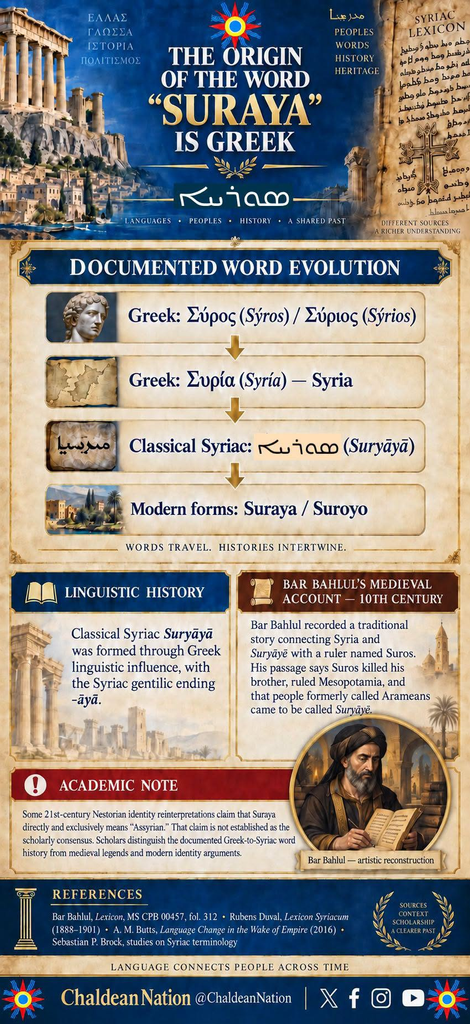
The history of a word can sometimes open a window into the history of an entire civilization. The word “Suraya” (ܣܘܪܝܝܐ), known in Classical Syriac as Suryāyā, is one such example—a term whose linguistic journey connects the ancient Greek world with the Syriac-speaking peoples of the Near East.
A Word That Traveled Across Civilizations
According to the linguistic tradition presented in the accompanying infographic, the evolution of the name can be traced through several historical stages:
Greek: Σύρος (Sýros) / Σύριος (Sýrios)
↓
Greek: Συρία (Syría) — Syria
↓
Classical Syriac: ܣܘܪܝܝܐ (Suryāyā)
↓
Modern forms: Suraya / Suroyo
This proposed development illustrates how names and identities can move between languages, adapting naturally to the sounds, grammar, and traditions of the communities that inherit them.
In Classical Syriac, Suryāyā became an important designation associated with the Syriac-speaking peoples and their linguistic and cultural heritage. The form reflects the interaction between an older geographical name and the linguistic structure of Syriac, including its characteristic gentilic formation.
The Testimony of Bar Bahlul
An especially interesting historical reference comes from Bar Bahlul, a 10th-century Syriac scholar and lexicographer. His Lexicon preserves traditional explanations concerning the relationship between Syria, Syrians, and Suryāyē.
Such medieval sources are valuable because they provide a glimpse into how Syriac scholars themselves understood the history and meaning of these names. They remind us that words were not merely labels—they carried memories of peoples, places, languages, and inherited traditions.
Language as a Bridge Between Worlds
The story of Suraya is ultimately larger than the origin of a single word.
Ancient Greek, Syriac, Aramaic, and the languages of the Near East existed in centuries of cultural contact. Through trade, scholarship, religion, migration, and political change, words crossed linguistic boundaries and were reshaped by each generation.
That is why the history of a word can be so revealing.
A name may begin in one linguistic environment, enter another language, acquire a new grammatical form, and eventually become a powerful marker of cultural identity.
An Important Academic Perspective
The claim that “Suraya is Greek in origin” should be presented with appropriate scholarly caution. The relationship between Syria, Syrian, Suryāyā, and related ancient ethnonyms and place-names is a subject of longstanding linguistic and historical discussion.
While the Greek forms Syros / Syrios and Syria are well documented, scholars continue to debate the deeper etymology and the precise historical relationships among these terms. Therefore, the linguistic pathway illustrated above is best understood as one historical interpretation rather than an uncontested academic conclusion.
What remains undeniable, however, is the extraordinary interconnectedness of the languages and civilizations of the ancient Near East.
Words Travel. Histories Intertwine.
The story of Suryāyā invites us to look beyond modern borders and modern assumptions—to a world in which Greek and Syriac speakers lived within an interconnected cultural landscape.
A single word can preserve traces of that encounter.
And sometimes, by following the journey of a word across centuries, we discover something much greater: a shared human history written into language itself.
©2016 Copyright All Rights Reserved by Velvet Glow Daily